
What if a spacecraft could travel enormous distances without moving through space in the conventional way? Instead of accelerating toward a distant star, imagine contracting space in front of the spacecraft and expanding it behind. The spacecraft would remain inside a bubble while spacetime carried it forward.
This is the basic idea behind a warp drive.
The equation behind curved spacetime
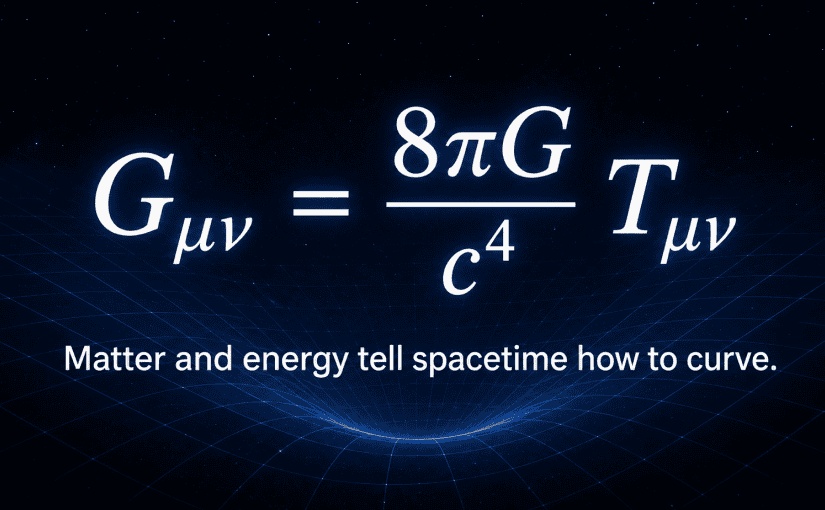
Einstein described the relationship between energy and spacetime with this equation:
Gμν = (8πG / c⁴) Tμν
In human language, it means:
Matter and energy tell spacetime how to curve.
The left side describes the shape of spacetime. The right side describes the matter, energy, pressure and motion responsible for creating that shape.
We commonly think of gravity as a force pulling objects together. Einstein offered a different picture: massive objects curve spacetime, and other objects follow paths through that curved geometry.
Earth curves the spacetime around it. The Moon follows that curvature as it orbits Earth. The Sun produces a much larger distortion, guiding the motion of planets throughout the Solar System.
Could we deliberately shape spacetime?
A warp drive would attempt to turn this natural process into technology.
Instead of using an engine to push a spacecraft through space, we would need an arrangement of matter and energy that creates a very specific geometry:
- Space contracts in front of the spacecraft.
- Space expands behind it.
- The spacecraft remains protected inside a stable region.
- The entire region moves toward the destination.
Locally, the spacecraft might never exceed the speed of light. However, changing the geometry between two locations could theoretically shorten the effective journey.
Mathematics allows scientists to describe such geometries. The problem is that we do not know how to produce the extraordinary energy configuration they require.
What would it take?
The critical breakthrough would be a new, controllable physical effect. Scientists would need to:
- Find a physically possible source for the required spacetime curvature.
- Demonstrate a tiny, measurable distortion in a laboratory.
- Create and stabilize a microscopic warp bubble.
- Learn to control that bubble from inside.
- Scale it up without destructive radiation or astronomical energy.
- Prove that it does not violate causality.
- Make it safe enough to carry matter and eventually people.
The first successful experiment would probably not move a spacecraft. It might produce an extremely small timing difference between precision clocks or move a particle by a barely measurable distance.
Where does 6174 fit?
The number 6174—known as Kaprekar’s constant—is a fascinating mathematical pattern. However, no established physical evidence currently connects it to gravity or propulsion.
For 6174 to become part of a physical theory, we would need to define exactly what it represents. Is it a frequency, ratio, geometric pattern or field configuration? Does it have units? Most importantly, can it produce a measurable prediction?
Interesting patterns can inspire scientific questions, but experiments determine whether those patterns describe nature.
The journey ahead
We do not yet know whether humanity will build a warp drive. It may require revolutionary technology, a deeper theory of gravity or entirely new physics. It may also turn out that nature forbids controllable faster-than-light travel.
But asking how spacetime works is still valuable. Every major scientific breakthrough began with someone looking beyond the familiar and asking whether reality could work differently.
The next step is not simply to imagine folded space—it is to find an equation, a physical mechanism and an experiment that can test the idea.